

Coastal Gifts That Give Back to Ocean Conservation
Capelandia proudly supports getting kids on the water to learn about ocean tech and science. Join us in supporting Our Blue Horizons!
Beach-lover gifts with a purpose — where every purchase helps protect the water it celebrates.
The best gifts do two things at once: they delight the person opening them, and they mean something. If there's a beach lover, boater, or ocean person in your life, a coastal gift that also protects the coast is about as good as gifting gets. You give something beautiful and you put a little good into the water they love.
Here's the thing most shoppers don't realize: a growing number of coastal brands quietly funnel part of every sale to conservation work. You just have to know to look for it. Below is our own take on gifts that give back — because we built our whole brand around exactly this idea.
What "gives back" should actually mean
Before the gift guide, a quick honest note, because "gives back" gets thrown around loosely. When you're shopping for a cause-driven gift, look for:
A specific nonprofit named, not a vague "we support the ocean."
A clear percentage or amount, so you know the giving is real.
A local or traceable impact you can actually picture.
That's the standard we hold ourselves to, so here's exactly how ours works: 10% of every Capelandia sale funds Our Blue Horizons, a Falmouth, Massachusetts marine conservation nonprofit. Their flagship program puts local kids on the water for hands-on ocean science — real boats, real research, real hours on the Cape's waters. When you buy something from us, you can picture exactly where the 10% goes: a kid getting out on the water, maybe for the first time.
Coastal gifts that give back
For the beach-lifestyle wearer
Soft, well-made coastal apparel is the everyday gift that gets worn all season. Our Cape Cod hoodies — the heavyweight Sea Fog and the lighter Tideline — carry the "Life at Sea Level" spirit in colors pulled straight from the Cape: smoky beige, dusk mauve, deep channel navy. It's the gift someone reaches for on every foggy morning and cool beach evening. (10% funds ocean conservation.)
For the coastal-food lover
Our Oyster Shucking Kit pairs a proper oyster knife with a "Life at Sea Level" tea towel — everything the home raw-bar host needs, wrapped up as a genuinely fun gift. Perfect for the friend who orders oysters every time and finally wants to shuck their own. (10% funds ocean conservation.)
For the boater or Cape Cod local
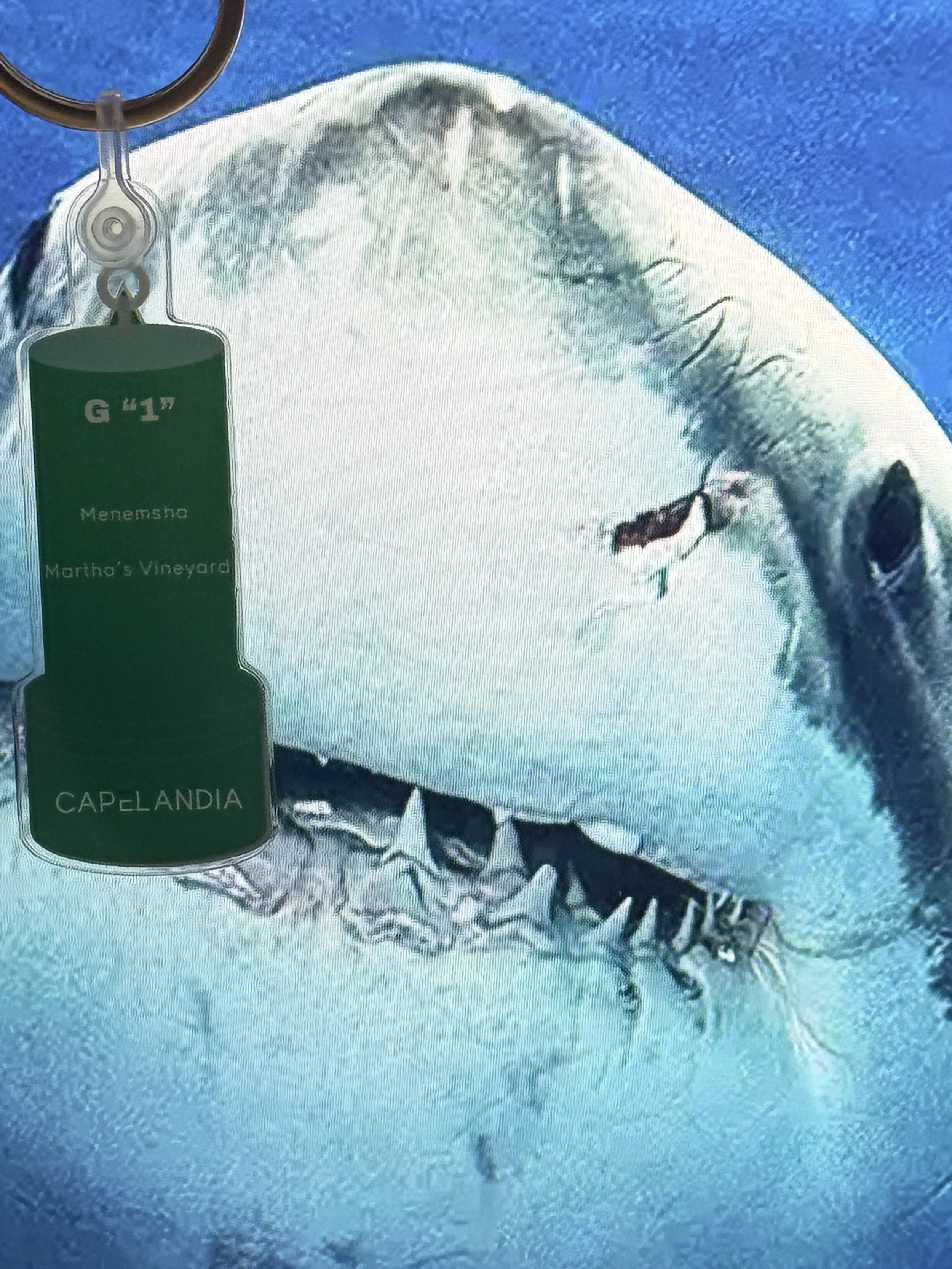
Our Collect the Coast keychains turn real Cape Cod channel-marker buoys into hand-drawn acrylic keychains — one harbor at a time. Give someone the buoy that means home to them: the Falmouth Inner Harbor marker, the Menemsha channel. It's small, personal, and instantly meaningful to anyone who knows that water. (10% funds ocean conservation.)
For the person who has everything
When you can't guess the size or the style, give the story. Any small purchase — a sticker, a keychain, a tote — still carries the same 10% mission. Sometimes the most meaningful gift is the smallest one that stands for something.
Why cause-driven gifts matter more than ever
Every coastline is under more pressure than it used to be, and the people who'll protect it next are kids who need a reason to fall in love with the water first. A gift that gives back turns an ordinary purchase into a small act of stewardship. The person on the receiving end gets something they'll actually use — and the coast gets an ally.
That's the whole idea behind what we make. Coastal style, with purpose.
Shop coastal gifts that give back
Browse our full lineup of Cape Cod apparel, oyster kits, keychains, and more at capelandia.com — where 10% of every sale funds marine conservation and gets local kids out on the water.
Life at Sea Level. — capelandia.com
What Cape Cod's Channel Markers Mean: A Captain's Guide to Buoys
Red right returning, nun vs. can, lateral vs. safe-water marks — a Cape Cod captain explains what channel marker buoys mean in plain English.
If you've ever brought a boat into a Cape Cod harbor — or just watched from the beach as one threaded its way in — you've seen them: the red and green buoys standing sentry at the mouth of every channel. They look simple. They are, in fact, a whole language. And once you can read it, the water tells you exactly where to go.
I've been a USCG-licensed captain in these waters for years, and I've steered past these markers in fog, at dawn, and at the end of long days when I could have found the channel with my eyes closed. Here's what they actually mean, in plain English.
The one rule that matters most: red right returning
If you remember nothing else, remember this: red, right, returning.
When you're returning from open water back toward the harbor, you keep the red markers on your right (starboard) side, and the green ones on your left. Heading back out to sea, it flips — red on your left, green on your right.
That single phrase keeps boats off the rocks and sandbars every day. The red and green markers form the two edges of a safe channel, and staying between them keeps you in the water that's deep enough to float you.
Red vs. green: the two sides of the channel
Red markers mark the right-hand edge of the channel as you come in from sea. In U.S. waters they carry even numbers.
Green markers mark the left-hand edge as you come in. They carry odd numbers.
The numbers count up as you head in from the ocean toward the harbor, so a low number like "2" means you're right at the entrance.
Nun vs. can: shape tells you the same story
The shapes back up the colors, which is handy when light or distance washes out the color.
A nun buoy is red, cone-shaped, and tapers to a point at the top. Red = nun. Even number.
A can buoy is green, flat-topped, and cylindrical like a tin can. Green = can. Odd number.
So "R '2'" — a red nun marked with the number 2 — is telling you a lot in three characters: red, right-side-returning, cone-shaped, and right at the harbor mouth.
Lateral marks vs. safe-water marks
Most of what you'll see are lateral marks — the red-and-green edge markers we've been talking about, which mark the sides of a defined channel.
There's another kind worth knowing: safe-water marks. These are red-and-white vertically striped, often topped with a red sphere, and they mean open, navigable water all around — a mid-channel or "start here" marker rather than an edge. They're a different message entirely: not stay to one side, but you're in clear water.
Why any of this matters (even if you never take the helm)
Channel markers are how a harbor keeps its people safe. They're the difference between coming home clean and finding a sandbar the hard way. But they're also something more than that. Every buoy sits in the same spot, year after year, through every season and every storm. If you run a particular harbor long enough, one of those markers becomes yours — the one that means you're almost home.
For us in Falmouth, that buoy is R "2," the first red nun at the entrance to the Inner Harbor. It's the marker we've passed a thousand times, and it's the reason it became the very first piece in our keychain series.
Collect your home harbor
Our Collect the Coast keychain series turns Cape Cod's channel markers into hand-drawn, double-sided acrylic keychains — one harbor at a time, drawn from the helm. R "2" Falmouth started it. Menemsha followed. Each one marks a real buoy you'd pass bringing a boat home.
They go on boat keys, house keys, or a kid's backpack heading off to school — a small piece of your home water to carry with you. And 10% of every sale funds Our Blue Horizons, our Falmouth marine conservation nonprofit putting local kids on the water. Your keychain literally helps put a kid on a boat.
Life at Sea Level. — capelandia.com
How to Host a Cape Cod Oyster Night
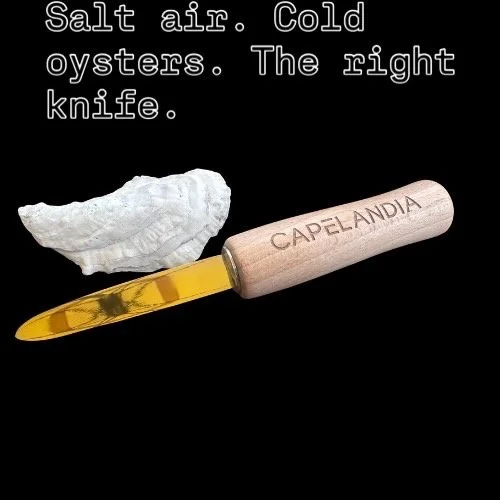
Coastal living- shuck like a pro with the Capelandia shucking knife and learn to host a shellfish party. Everything you need to throw a low-key, salt-air oyster gathering at home — from how many to buy to how to shuck them without losing a knuckle.
There's a particular kind of Cape Cod evening that doesn't need much: a few dozen oysters on ice, good people on the porch, the light going gold over the water, and no one in a hurry. You don't need a raw bar or a caterer to pull it off. You need cold oysters, one good knife, and a little know-how.
Here's how to host an oyster night at home the Cape Cod way — relaxed, briny, and easier than you think.
Step 1: Figure out how many oysters to buy
The single most-asked question, so let's answer it first.
As an appetizer or one part of a spread: plan on 6 oysters per person.
As the main event of the night: plan on 12 per person — the oyster people will happily eat more, so round up.
For a gathering of 8, that's roughly 4 to 8 dozen. Oysters are sold by the dozen or in bulk bags of 50 or 100. If you're near a Cape farm or fish market, a bag of 100 is the move for a real crowd — and it's cheaper by the piece.
Buy them as close to the party as you can — same day is ideal. Fresh oysters are alive; you want them tight-shelled and briny, not sitting in your fridge for days.
Step 2: Buy local, and buy Cape
Half the magic of a Cape Cod oyster night is the oysters themselves. Wellfleet, Cotuit, Barnstable, Chatham — each has its own flavor, from bright and briny to sweet and mild. If you can, get a mix from two or three spots and let guests taste the difference. It turns eating into a little tour of the Cape's waters, and it's a great conversation starter.
Ask your fishmonger which came in most recently. Local, cold, and just-harvested beats anything shipped from away.
Step 3: Gather what you'll need
You need less than you'd think:
Oysters, scrubbed and kept cold
A real oyster knife — short, sturdy blade with a guard. Do not substitute a kitchen knife; that's how people get hurt.
A shucking glove or a folded kitchen towel to protect your holding hand
A big platter or sheet pan of crushed ice to serve on and keep them cold
Lemon wedges, hot sauce, cocktail sauce, and a mignonette (recipe below)
Small forks (optional — purists just slurp)
A bowl for empty shells*
Don’t forget to return the empty shells back to the sea!
That's the whole kit. Set it up on one table and let people gather around it.
Step 4: Make a mignonette (the 5-minute upgrade)
A classic mignonette makes your oyster night feel done-right with almost no effort. Combine:
1/4 cup red wine vinegar
1 small shallot, finely minced
A few cracks of fresh black pepper
(Optional) a splash of lemon
Stir it together, let it sit 15 minutes so the shallot mellows, and serve it in a small bowl with a little spoon. That's it. It keeps in the fridge for days.
Step 5: Shuck like a local
If you've never shucked, here's the short version:
Set the oyster cupped-side down on your folded towel, so the briny liquor stays inside.
Find the hinge — the pointed end where the two shells meet. That's your way in.
Work the knife tip into the hinge with steady pressure and a little side-to-side wiggle — not a stab. When you feel a pop, you're in.
Twist the knife like a key to pop the top shell.
Slide the blade along the top shell to cut the muscle, lift the top off, then run the blade under the oyster along the bottom shell to free it. That last step is what makes it easy to slurp.
Keep it level, pick out any shell bits, and set it on the ice.
The golden safety rule: never let the knife point toward your hand. Go slow on your first few — speed comes on its own.
Hosting tip: you don't have to shuck all of them yourself. Set up a little shucking station and let a couple of confident guests take turns. It becomes part of the fun, and it saves your wrist.
Step 6: Set the scene
This is Cape Cod, so keep it unfussy. A few things that make it feel like a night:
Serve outside if you can — porch, deck, backyard, dockside.
Crushed ice on a big tray or in a galvanized tub looks the part and does the job.
A stack of cloth napkins or a good tea towel beats paper.
A cold, crisp drink — a dry white, a light lager, or something sparkling. Briny oysters love acidity and bubbles.
Save the pretty shells — rinsed and dried, they make great little dishes, place-card holders, or décor for the next one.
Step 7: Slurp, and don't overthink it
Tip the shell to your lips, let the oyster and its liquor go together, and taste the cold water it came from. A squeeze of lemon or a dab of mignonette if you like — or nothing at all. That's the whole ritual. Simple, briny, and unmistakably Cape.
Make it a tradition
The best oyster nights become a thing you do — end of summer, first cool evening of fall, whenever the people you like are around. It's low-effort, high-reward, and it tastes like the Cape.
Set yourself up with the right kit
We put together our Capelandia Oyster Shucking Kit for exactly these evenings — a proper oyster knife paired with our "Life at Sea Level" tea towel, so you've got the right tool and something to catch the drips. It makes a great gift for the host in your life, too.
And like everything we make, it gives back: 10% of every sale funds Our Blue Horizons, a Falmouth-based marine conservation nonprofit that puts local kids on the water to learn about the ocean — the same clean Cape waters that grow a good oyster.
Life at Sea Level. — capelandia.com